The Ethereum network has undergone one of the most important transformations in blockchain history. With the transition from Proof of Work to Proof of Stake, Ethereum introduced a new consensus architecture centered around validators, staking, epochs, and the Beacon Chain. This created a new category of blockchain data that users need to understand.
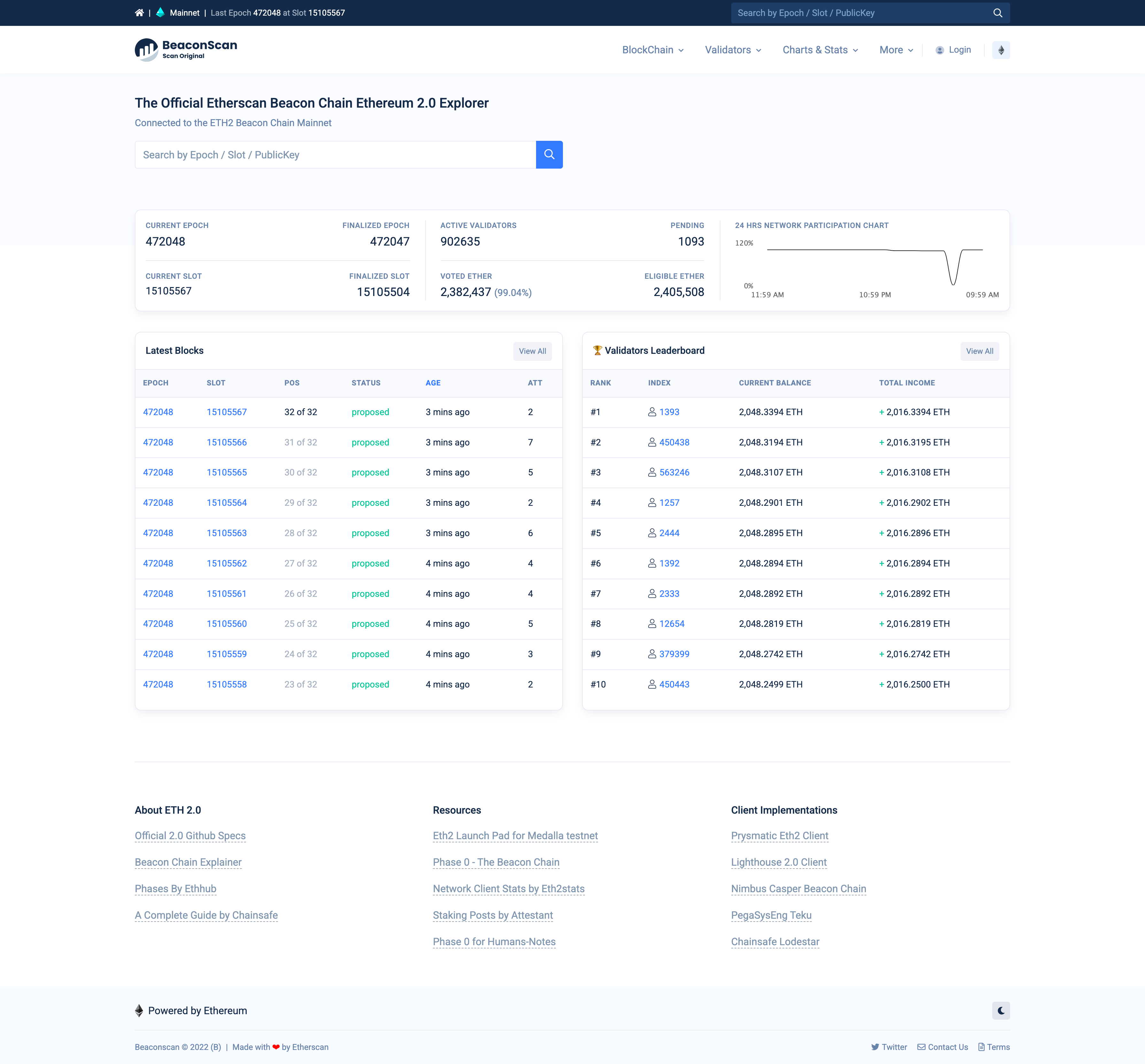
BeaconScan is a blockchain explorer focused on Ethereum's Beacon Chain and its Proof-of-Stake consensus layer. It provides users with tools to explore validators, blocks, slots, epochs, deposits, withdrawals, staking activity, and other information associated with Ethereum's consensus layer.
For people who own ETH, operate validators, research Ethereum staking, or simply want to understand how Ethereum works after its transition to Proof of Stake, BeaconScan can be a valuable source of on-chain information.
This article explains what BeaconScan is, how it works, its major features, the importance of validators and epochs, Ethereum staking, withdrawals, and how users can use BeaconScan to analyze the network.
What Is BeaconScan?
BeaconScan is an Ethereum Beacon Chain explorer designed to make Proof-of-Stake network data accessible through a searchable interface.
Traditional blockchain explorers primarily focused on transaction data. The Beacon Chain introduced additional concepts, including validators, attestations, slots, epochs, deposits, and consensus rewards.
BeaconScan helps users examine these components.
A user can search or explore information associated with:
Beacon Chain blocks
Slots
Epochs
Validators
Validator deposits
Attestations
Withdrawals
Staking activity
Network statistics
This makes BeaconScan particularly useful for understanding Ethereum's consensus layer.
Understanding Ethereum's Beacon Chain
The Beacon Chain was introduced as the foundation of Ethereum's Proof-of-Stake system.
Ethereum previously relied on miners to secure the network through Proof of Work. After the transition to Proof of Stake, validators became responsible for participating in consensus.
Validators deposit ETH into the staking system and perform duties that help the network agree on the canonical blockchain.
The Beacon Chain coordinates these validators and organizes consensus activity into structured units.
Today, Ethereum's execution and consensus layers work together. The execution layer handles transactions and smart-contract operations, while the consensus layer manages Proof-of-Stake coordination.
An explorer focused on the Beacon Chain therefore provides information that differs from what users might see on a traditional Ethereum transaction explorer.
Validators
Validators are at the heart of Ethereum's Proof-of-Stake system.
A validator is an entity participating in Ethereum's consensus process by maintaining validator software and performing assigned duties.
Validators can propose blocks and participate in attestations.
Their behavior affects their rewards and their standing within the network.
BeaconScan allows users to examine individual validators and view publicly available information associated with them.
This can include:
Validator status
Effective balance
Activation information
Attestation performance
Proposal activity
Withdrawals
Validator lifecycle information
For people operating validators, these statistics can be especially useful.
Validator Performance
Running an Ethereum validator requires consistent participation.
A validator must remain online and perform its assigned duties correctly.
One of those duties is submitting attestations.
Attestations are votes that validators make concerning the state of the Ethereum blockchain.
A validator that consistently performs its responsibilities can earn rewards, while missed duties can reduce expected rewards.
BeaconScan can help validator operators monitor their performance.
This makes the explorer useful not only for casual observers but also for people actively participating in Ethereum staking.
Slots and Epochs
Two important concepts in Ethereum's Proof-of-Stake system are slots and epochs.
A slot represents a period during which a block may be proposed.
Slots are organized into epochs.
An epoch consists of multiple slots and provides a larger unit for organizing validator activity and consensus processes.
For someone new to Ethereum's consensus layer, these terms may initially seem technical. However, they are essential for understanding how Proof of Stake operates.
BeaconScan makes this information visible, allowing users to explore individual slots and epochs rather than treating the blockchain as a single continuous sequence.
Beacon Chain Blocks
Blocks are fundamental components of any blockchain.
On Ethereum's consensus layer, Beacon Chain blocks contain information related to the network's Proof-of-Stake operation.
Users can explore blocks to examine information such as:
Slot number
Epoch
Block proposer
Attestations
Deposits
Voluntary exits
Withdrawals
Other consensus-related data
This provides a deeper perspective into Ethereum's network than simply looking at ordinary token transfers.
Ethereum Staking
Ethereum staking is one of the most important developments associated with the Proof-of-Stake transition.
Instead of requiring miners to use computing power and electricity to secure the network, Ethereum allows participants to stake ETH and operate validators.
A full validator traditionally requires a deposit of 32 ETH, although the broader staking ecosystem now includes various services and mechanisms that allow users with smaller amounts to participate indirectly.
Staking can generate rewards, but it also involves technical and financial risks.
Validator operators must maintain their infrastructure and ensure that their software functions correctly.
Staking Rewards
Ethereum validators can earn rewards for performing their responsibilities.
These rewards can come from activities such as:
Attestations
Block proposals
Other consensus-related participation
The amount earned depends on several factors, including network conditions, validator performance, and the validator's effective balance.
BeaconScan can help users examine validator activity and associated reward information.
However, users should not assume that historical rewards represent guaranteed future returns.
Ethereum staking economics can change over time.
Deposits
The Ethereum staking system requires validators to make deposits.
BeaconScan allows users to investigate deposit-related information.
This can be particularly useful for verifying when a validator entered the staking system and examining information associated with its deposit.
Deposits connect the Ethereum execution layer with the consensus layer.
Understanding this relationship helps explain how ETH moves into the validator lifecycle.
Validator Activation
After a validator deposit is made, the validator does not necessarily become active immediately.
The Ethereum network has processes governing validator activation.
Depending on network conditions, validators may experience an activation queue.
BeaconScan can provide information about validator status and activation.
For users who have recently deposited ETH for staking, this information can help explain why a validator may not immediately begin performing duties.
Validator Withdrawals
Ethereum's post-Shanghai/Capella upgrade environment introduced the ability for validators to withdraw staked ETH and accumulated rewards under the applicable withdrawal mechanisms.
This was a major development for Ethereum staking.
Before withdrawals were enabled, ETH deposited into the Beacon Chain could not simply be withdrawn in the same way.
With withdrawals available, validator operators can monitor withdrawal activity through consensus-layer data.
BeaconScan can therefore help users investigate when withdrawals occurred and how they relate to particular validators.
Attestations
Attestations are a core component of Ethereum Proof of Stake.
Validators regularly vote on the state of the chain.
These votes help Ethereum reach consensus about which blocks and chain history should be considered valid.
A validator's attestation performance is therefore an important indicator of its participation.
BeaconScan provides visibility into this activity, helping users understand how validators contribute to network security.
Block Proposals
Validators can also be selected to propose blocks.
A block proposer is responsible for producing a block during an assigned slot.
Successfully proposing a valid block can generate rewards.
Because block proposals are relatively infrequent for an individual validator compared with attestations, operators may use explorers to verify when their validator has been selected.
BeaconScan makes this activity publicly inspectable.
Network Transparency
One of the most important benefits of BeaconScan is transparency.
Ethereum's Proof-of-Stake system involves thousands of validators distributed across different operators and geographic locations.
A public explorer provides a way to examine network participation without relying solely on private dashboards.
Users can investigate:
Validator counts
Active validators
Network participation
Block production
Attestation activity
Deposits
Withdrawals
This transparency can contribute to greater understanding of Ethereum's decentralized consensus system.
BeaconScan for Developers
Developers working with Ethereum infrastructure can use BeaconScan as a research and debugging resource.
When building staking applications, validator dashboards, analytics systems, or other blockchain tools, developers may need to examine real network data.
An explorer can help them understand:
Validator lifecycle
Block structure
Epoch transitions
Attestation activity
Withdrawal behavior
Consensus-layer events
This information can complement Ethereum APIs and developer tools.
BeaconScan for Investors
BeaconScan can also be useful for cryptocurrency investors and researchers.
For example, someone studying Ethereum staking can examine validator activity and network participation rather than relying exclusively on third-party summaries.
On-chain data can provide a more direct view of network behavior.
However, users should remember that blockchain information is only one part of investment research.
Validator statistics do not predict the future price of ETH, and strong network activity does not guarantee that ETH will increase in value.
Comparing BeaconScan With Ethereum Transaction Explorers
Ethereum users may already be familiar with explorers focused on the execution layer.
These platforms are excellent for examining:
ETH transfers
ERC-20 tokens
Smart contracts
Gas fees
DeFi transactions
NFTs
BeaconScan serves a different purpose.
Its focus is the Ethereum consensus layer and Proof-of-Stake infrastructure.
This means it is particularly useful for examining:
Validators
Epochs
Slots
Attestations
Consensus blocks
Deposits
Withdrawals
The two types of explorers can therefore complement each other.
Security and Privacy
Although BeaconScan provides public blockchain information, users should understand that blockchain activity is transparent.
Validator addresses and related information may be publicly visible.
Organizations operating validators should consider the implications of publicly associating infrastructure with specific entities.
Users should also be cautious about phishing websites that imitate legitimate blockchain explorers.
A blockchain explorer itself generally does not require users to provide private keys or recovery phrases simply to inspect public blockchain information.
Anyone requesting sensitive wallet credentials in exchange for basic explorer access should be treated with extreme caution.
Limitations of BeaconScan
BeaconScan provides valuable data, but it cannot answer every question.
An explorer can show what occurred on the blockchain, but it cannot always explain why something happened.
For example, it may show that a validator was offline or missed attestations, but additional information may be needed to determine whether the cause was a server failure, software issue, network outage, or another problem.
Similarly, explorer statistics should be interpreted within the broader context of Ethereum's architecture.
The Importance of Beacon Explorers
As Proof-of-Stake becomes increasingly common across blockchain networks, specialized consensus explorers are becoming more important.
The data produced by modern proof-of-stake networks is much more complex than simple transaction records.
Users need tools to understand:
Validators
Delegation
Consensus
Rewards
Slashing
Epochs
Network participation
Withdrawals
BeaconScan is part of this broader evolution toward more detailed blockchain analytics.
The Future of Ethereum's Consensus Layer
Ethereum continues to evolve through protocol upgrades designed to improve scalability, security, efficiency, and usability.
As the network changes, the amount and complexity of consensus-layer data will also continue to grow.
This could create demand for more advanced explorer features, including improved validator analytics, historical performance comparisons, reward analysis, network visualization, and developer-oriented APIs.
The role of blockchain explorers may therefore expand from simple search tools into comprehensive analytics platforms.
Conclusion
BeaconScan is a useful resource for exploring Ethereum's Proof-of-Stake infrastructure. By focusing on validators, slots, epochs, blocks, attestations, deposits, withdrawals, and other consensus-related information, it provides a different perspective from traditional Ethereum transaction explorers.
For validator operators, BeaconScan can help monitor performance and investigate validator activity. For stakers, it can provide greater transparency into the Ethereum staking system. Developers can use it to research consensus-layer behavior, while investors and researchers can use its data to better understand Ethereum's network.
The transition to Proof of Stake fundamentally changed how Ethereum is secured. Validators replaced miners as the primary participants in consensus, and concepts such as staking, attestations, epochs, and validator withdrawals became central to the network.
BeaconScan helps make these technical processes easier to explore.
As Ethereum continues to develop and its staking ecosystem grows, transparent and accessible blockchain explorers will remain valuable. Tools such as BeaconScan demonstrate the importance of turning complex blockchain infrastructure into information that ordinary users, developers, and researchers can inspect and understand.

No Code Website Builder